RL Notes (2): Value-Based RL
2025-12-19 · Qi Lu · Views:
In the previous article, we defined value functions $V^\pi(s)$ and $Q^\pi(s,a)$, which measure how “good” a state or state-action pair is under policy $\pi$. The natural questions now are:
How do we compute value functions? How do we derive the optimal policy from value functions?
The answers to these questions form the core of Value-Based RL. This article introduces three categories of methods:
- Dynamic Programming (DP): Exact solutions when the environment model is known
- Model-free Estimation (MC and TD): Learning from samples when the model is unknown
- Deep Q-Networks (DQN): Handling large or continuous state spaces
1. Why Learn Value Functions?
A core observation is: if we know the optimal action value function $Q^*(s,a)$, we can directly derive the optimal policy:
\[\pi^*(s) = \arg\max_a Q^*(s,a)\]This is the theoretical foundation of Value-Based methods—instead of learning the policy directly, we obtain it indirectly by learning the value function.

2. Bellman Equations
The Bellman equation is the core equation of RL, revealing the recursive structure of value functions. Understanding Bellman equations is the foundation for mastering all Value-Based methods.
2.1 Intuition: One-Step Decomposition
The core form of the Bellman equation is:
\[V^\pi(s) = \mathbb{E} \left[ r + \gamma V^\pi(s') \right]\]In words: value of current state = immediate reward + discounted value of next state.
This recursive relationship allows us to compute value functions through iteration, without enumerating all possible trajectories.
2.2 Bellman Expectation Equation
Theorem (Bellman Expectation Equation for $V^\pi$): For any policy $\pi$, the state value function satisfies:
\[V^\pi(s) = \sum_{a \in \mathcal{A}} \pi(a|s) \left[ R(s,a) + \gamma \sum_{s' \in \mathcal{S}} P(s'|s,a) V^\pi(s') \right]\]Proof: Starting from the definition of state value function:
\[\begin{aligned} V^\pi(s) &= \mathbb{E}_\pi \left[ G_t \mid S_t = s \right] \\ &= \mathbb{E}_\pi \left[ r_t + \gamma G_{t+1} \mid S_t = s \right] \\ &= \mathbb{E}_\pi \left[ r_t + \gamma V^\pi(S_{t+1}) \mid S_t = s \right] \end{aligned}\]Expanding the expectation: given $S_t = s$, action $A_t = a$ has probability $\pi(a|s)$; given $(s, a)$, next state $S_{t+1} = s’$ has probability $P(s’|s,a)$.
Similarly, the Bellman Expectation Equation for action value function:
\[Q^\pi(s,a) = R(s,a) + \gamma \sum_{s' \in \mathcal{S}} P(s'|s,a) \sum_{a' \in \mathcal{A}} \pi(a'|s') Q^\pi(s',a')\]The mutual representation of $V^\pi$ and $Q^\pi$ is key to deriving Bellman equations: \(V^\pi(s) = \sum_{a} \pi(a|s) Q^\pi(s,a)\) \(Q^\pi(s,a) = R(s,a) + \gamma \sum_{s'} P(s'|s,a) V^\pi(s')\)
2.3 Bellman Optimality Equation
Optimal value functions satisfy the Bellman Optimality Equation. Unlike the Expectation version, here we take the maximum over actions instead of expectation.
Theorem (Bellman Optimality Equation for $V^{*}$):
\[V^*(s) = \max_{a \in \mathcal{A}} \left[ R(s,a) + \gamma \sum_{s' \in \mathcal{S}} P(s'|s,a) V^*(s') \right]\]Theorem (Bellman Optimality Equation for $Q^{*}$):
\[Q^*(s,a) = R(s,a) + \gamma \sum_{s' \in \mathcal{S}} P(s'|s,a) \max_{a' \in \mathcal{A}} Q^*(s',a')\]Key difference between Bellman Expectation and Bellman Optimality:
- Bellman Expectation: Weighted average over actions (by $\pi(a|s)$), describes value of a given policy
- Bellman Optimality: Maximum over actions ($\max_a$), describes value of the optimal policy
Q-Learning directly approximates $Q^*$, hence uses Bellman Optimality Equation as the update target.
2.4 Relationship Between $V^{*}$ and $Q^{*}$
The optimal value functions have a concise relationship:
\[V^*(s) = \max_a Q^*(s,a)\] \[Q^*(s,a) = R(s,a) + \gamma \sum_{s'} P(s'|s,a) V^*(s')\]The optimal policy can be derived directly from $Q^{*}$:
\[\pi^*(s) = \arg\max_a Q^*(s,a)\]This is the theoretical foundation of Q-Learning methods: once we learn $Q^{*}$, we immediately get the optimal policy.
2.5 Bellman Operator and Contraction Property
Definition (Bellman Operator):
\[(\mathcal{T}^\pi V)(s) = \sum_a \pi(a|s) \left[ R(s,a) + \gamma \sum_{s'} P(s'|s,a) V(s') \right]\] \[(\mathcal{T}^* V)(s) = \max_a \left[ R(s,a) + \gamma \sum_{s'} P(s'|s,a) V(s') \right]\]Theorem (Contraction Property of Bellman Operator): The Bellman operator is a $\gamma$-contraction mapping:
\[\| \mathcal{T}^\pi V_1 - \mathcal{T}^\pi V_2 \|_\infty \leq \gamma \| V_1 - V_2 \|_\infty\]Proof: For any state $s$:
\[\begin{aligned} |(\mathcal{T}^\pi V\_1)(s) - (\mathcal{T}^\pi V\_2)(s)| &= \left| \gamma \sum\_a \pi(a|s) \sum\_{s'} P(s'|s,a) [V\_1(s') - V\_2(s')] \right| \\\\ &\leq \gamma \sum\_a \pi(a|s) \sum\_{s'} P(s'|s,a) |V\_1(s') - V\_2(s')| \\\\ &\leq \gamma \| V\_1 - V\_2 \|\_\infty \end{aligned}\]Taking maximum over all $s$ yields the result. The same applies to $\mathcal{T}^{*}$.
Important corollaries of contraction property:
- Unique fixed point: Bellman operator has a unique fixed point $V^\pi$ (or $V^*$)
- Iterative convergence: Starting from any $V_0$, $V_{k+1} = \mathcal{T}V_k$ converges to the fixed point
- Convergence rate: Error decays exponentially at rate $\gamma^k$
3. Dynamic Programming Methods
When environment model $P(s’|s,a)$ and $R(s,a)$ are fully known, Dynamic Programming (DP) methods can exactly solve for the optimal policy.
3.1 Policy Evaluation
Given policy $\pi$, compute $V^\pi$ by iterating the Bellman Expectation equation:
\[V_{k+1}(s) = \sum_a \pi(a|s) \left[ R(s,a) + \gamma \sum_{s'} P(s'|s,a) V_k(s') \right]\]Starting from any $V_0$, iterate until convergence $V_k \to V^\pi$.
3.2 Policy Improvement
Theorem (Policy Improvement Theorem): Let $\pi$ and $\pi’$ be two policies. If for all $s \in \mathcal{S}$:
\[Q^\pi(s, \pi'(s)) \geq V^\pi(s)\]then $\pi’$ is at least as good as $\pi$: for all $s$, $V^{\pi’}(s) \geq V^\pi(s)$.
Greedy Policy Improvement:
\[\pi'(s) = \arg\max_a Q^\pi(s,a) = \arg\max_a \left[ R(s,a) + \gamma \sum_{s'} P(s'|s,a) V^\pi(s') \right]\]3.3 Policy Iteration
Alternate between Policy Evaluation and Policy Improvement:

For finite MDPs, Policy Iteration converges to optimal policy $\pi^*$ in finite steps.
3.4 Value Iteration
Combine Policy Evaluation and Policy Improvement into one step, directly iterating the Bellman Optimality equation:
\[V_{k+1}(s) = \max_a \left[ R(s,a) + \gamma \sum_{s'} P(s'|s,a) V_k(s') \right]\]After convergence, $\pi^*(s) = \arg\max_a \left[ R(s,a) + \gamma \sum_{s’} P(s’|s,a) V(s’) \right]$.
| Policy Iteration | Value Iteration | |
|---|---|---|
| Policy Evaluation | Full solve for $V^\pi$ | Only one Bellman update |
| Theoretical basis | Bellman Expectation | Bellman Optimality |
| Per-iteration complexity | High (multiple inner loops) | Low (single sweep) |
| Iterations to converge | Few | Many |
3.5 Limitations of DP Methods
- Requires complete model: Must know $P(s’|s,a)$ and $R(s,a)$
- State space enumeration: Each iteration requires sweeping all states, complexity $O(|\mathcal{S}|^2 |\mathcal{A}|)$
- Cannot handle continuous spaces: Tabular methods don’t apply directly
These limitations motivated the development of model-free methods (MC, TD) and function approximation (DQN).
4. Model-free Methods: Monte Carlo vs Temporal Difference
When the environment model is unknown, we need to estimate value functions from samples of interaction.
4.1 Monte Carlo Estimation
The core idea of MC: use actual trajectory returns $G_t$ to estimate the expectation.
Monte Carlo Update:
\[V(S_t) \leftarrow V(S_t) + \alpha \left( G_t - V(S_t) \right)\]where $G_t = \sum_{k=0}^{T-t-1} \gamma^k r_{t+k}$ is the actual return from time $t$ to episode end.
MC method characteristics:
- Must wait for episode to end to compute $G_t$, only for episodic tasks
- Unbiased estimate: $\mathbb{E}[G_t | S_t = s] = V^\pi(s)$
- High variance: $G_t$ accumulates randomness from the entire trajectory
- No bootstrapping: Target comes entirely from real samples
4.2 Temporal Difference Estimation
The core idea of TD: use “one-step reward + estimated value of next state” to replace full return.
TD(0) Update:
\[V(S_t) \leftarrow V(S_t) + \alpha \left( \underbrace{r_t + \gamma V(S_{t+1})}_{\text{TD target}} - V(S_t) \right)\]TD error: $\delta_t = r_t + \gamma V(S_{t+1}) - V(S_t)$
TD method characteristics:
- Can update every step, suitable for continuing tasks and online learning
- Biased estimate: Uses estimated $V(S_{t+1})$
- Low variance: Only uses single-step reward
- Uses bootstrapping: Uses current estimate $V(S_{t+1})$ to update $V(S_t)$
4.3 Bias-Variance Trade-off
| Monte Carlo | TD(0) | |
|---|---|---|
| Target | $G_t$ (actual return) | $r_t + \gamma V(S_{t+1})$ |
| Bias | Unbiased | Biased (depends on $V$ estimate) |
| Variance | High (accumulates trajectory randomness) | Low (only single-step randomness) |
| Bootstrap | No | Yes |
| Task type | Episodic only | Episodic and Continuing |
Why does TD have lower variance?
MC target $G_t = r_t + \gamma r_{t+1} + \gamma^2 r_{t+2} + \cdots$ contains all rewards from $t$ to termination, variances add up. TD target only has $r_t$ and $S_{t+1}$ as random variables—although $V(S_{t+1})$ may be inaccurate (biased), it doesn’t accumulate randomness.
4.4 n-step TD and TD(λ)
n-step TD is intermediate between MC and TD(0):
\[G_t^{(n)} = r_t + \gamma r_{t+1} + \cdots + \gamma^{n-1} r_{t+n-1} + \gamma^n V(S_{t+n})\]- $n=1$: TD(0)
- $n=\infty$: Monte Carlo
TD(λ) method computes weighted average of all n-step returns:
\[G_t^\lambda = (1-\lambda) \sum_{n=1}^{\infty} \lambda^{n-1} G_t^{(n)}\]- $\lambda = 0$: Equivalent to TD(0)
- $\lambda = 1$: Equivalent to Monte Carlo
5. Q-Learning and SARSA
To find the optimal policy, we need to estimate action value function $Q$, so we can derive policy via $\arg\max$.
5.1 On-policy vs Off-policy
- On-policy: Evaluate and improve the same policy (behavior policy = target policy)
- Off-policy: Use behavior policy to collect data, evaluate/improve a different target policy
Off-policy advantages:
- Can learn from historical data (Experience Replay)
- Can learn from human demonstrations or other policies
5.2 SARSA (On-policy)
SARSA is an on-policy TD control method, named after the quintuple $(S_t, A_t, R_t, S_{t+1}, A_{t+1})$ needed for updates.
SARSA Update:
\[Q(S_t, A_t) \leftarrow Q(S_t, A_t) + \alpha \left( r_t + \gamma Q(S_{t+1}, A_{t+1}) - Q(S_t, A_t) \right)\]where $A_{t+1}$ is the action actually sampled according to current policy (e.g., $\epsilon$-greedy).
5.3 Q-Learning (Off-policy)
Q-Learning directly approximates optimal $Q^*$, not the current policy’s $Q^\pi$.
Q-Learning Update:
\[Q(S_t, A_t) \leftarrow Q(S_t, A_t) + \alpha \left( r_t + \gamma \max_{a'} Q(S_{t+1}, a') - Q(S_t, A_t) \right)\]Key difference: SARSA uses $Q(S_{t+1}, A_{t+1})$ (actually sampled action), Q-Learning uses $\max_{a’} Q(S_{t+1}, a’)$ (optimal action).
Theorem (Q-Learning Convergence): Q-Learning converges to $Q^{*}$ under the following conditions:
- All state-action pairs are visited infinitely often
- Learning rate satisfies Robbins-Monro conditions: $\sum_t \alpha_t = \infty$, $\sum_t \alpha_t^2 < \infty$
5.4 $\epsilon$-greedy Exploration Strategy
To ensure sufficient exploration, the $\epsilon$-greedy strategy is commonly used:
\[\pi(a|s) = \begin{cases} 1 - \epsilon + \frac{\epsilon}{|\mathcal{A}|} & \text{if } a = \arg\max_{a'} Q(s,a') \\\\ \frac{\epsilon}{|\mathcal{A}|} & \text{otherwise} \end{cases}\]In words: with probability $1 - \epsilon$ select the greedy action; with probability $\epsilon$ select uniformly at random.
Why is exploration necessary?
- Insufficient initial data: Early $Q$ estimates are inaccurate; always taking greedy actions may miss good actions
- Local optima trap: Without exploration, the agent cannot discover better strategies
- Theoretical guarantee: Q-Learning convergence requires all state-action pairs to be visited infinitely often
$\epsilon$ decay strategy: Typically start with high exploration ($\epsilon = 1$) and gradually decay (e.g., $\epsilon \to 0.01$). This achieves “explore early, exploit later”.
5.5 Cliff Walking Example
Cliff Walking is a classic Grid World environment that clearly demonstrates the behavioral difference between Q-Learning and SARSA:
- Q-Learning: Learns optimal path (along cliff edge), but often falls during training due to exploration
- SARSA: Learns conservative path accounting for exploration, staying away from cliff edge
Root cause: SARSA’s target includes actually executed exploration actions; Q-Learning’s target always selects $\max$.
| Q-Learning | SARSA | |
|---|---|---|
| Type | Off-policy | On-policy |
| TD target | $r + \gamma \max_{a’} Q(s’,a’)$ | $r + \gamma Q(s’, a’)$ |
| Learning target | $Q^*$ (optimal policy) | $Q^\pi$ (current policy) |
| Behavior | More aggressive/optimistic | More conservative |
6. Deep Q-Network (DQN)
Tabular Q-Learning cannot handle large state spaces (like image inputs) or continuous state spaces. DQN uses neural networks to approximate $Q^*$, pioneering deep reinforcement learning.
6.1 Motivation for Function Approximation
Tabular method limitations:
- State space explosion: Atari game pixel space is about $256^{210 \times 160 \times 3}$
- No generalization: Cannot handle unseen states
- Continuous states: Cannot be represented by tables
Solution: Use parameterized function $Q(s,a;\theta)$ (e.g., neural network) to approximate $Q^*$.
6.2 DQN Loss Function
Transform Q-Learning update into a regression problem:
\[\mathcal{L}(\theta) = \mathbb{E}_{(s,a,r,s') \sim \mathcal{D}} \left[ \left( \underbrace{r + \gamma \max_{a'} Q(s',a';\theta^-)}_{\text{TD target } y} - Q(s,a;\theta) \right)^2 \right]\]where $\mathcal{D}$ is the Replay Buffer, $\theta^-$ is the Target Network parameters.
6.3 Experience Replay
Store transitions $(s_t, a_t, r_t, s_{t+1})$ in Replay Buffer $\mathcal{D}$, randomly sample mini-batches from $\mathcal{D}$ for training.
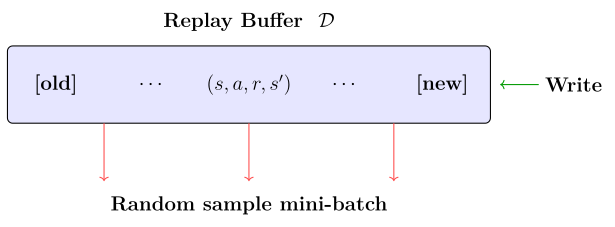
Benefits of Experience Replay:
- Break sample correlation: Random sampling provides more independent samples
- Improve data efficiency: Each sample can be reused multiple times
- Stabilize data distribution: Buffer distribution changes slowly
6.4 Target Network
Use old parameters $\theta^-$ to compute TD target, periodically update $\theta^- \leftarrow \theta$ (e.g., every $C$ steps).
Target Network purpose:
- Avoid oscillation or divergence from target “chasing” current estimate
- TD target stays fixed for a period, similar to fixed labels in supervised learning
A variant is Soft Update: $\theta^- \leftarrow \tau \theta + (1 - \tau) \theta^-$, where $\tau \ll 1$.
6.5 DQN Algorithm
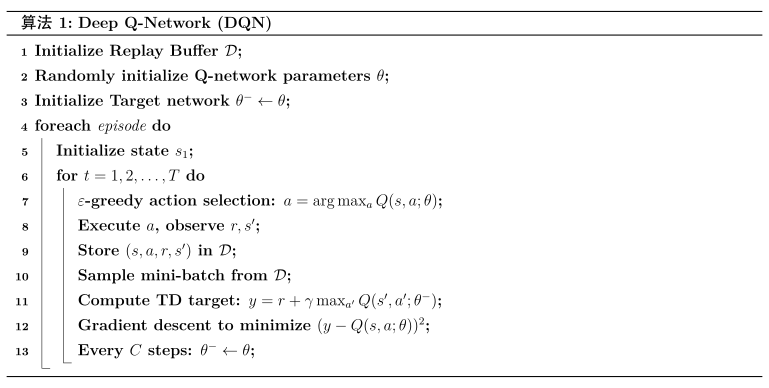
DQN’s two key techniques solve deep RL stability problems:
- Experience Replay: Addresses sample correlation, improves data efficiency
- Target Network: Addresses target instability, prevents oscillation and divergence
6.6 DQN Variants
Double DQN: Addresses overestimation by decoupling action selection and value evaluation:
\[y = r + \gamma Q\left(s', \arg\max_{a'} Q(s',a';\theta); \theta^-\right)\]Dueling DQN: Decomposes Q value into state value and action advantage:
\[Q(s,a;\theta) = V(s;\theta_v) + \left( A(s,a;\theta_a) - \frac{1}{|\mathcal{A}|} \sum_{a'} A(s,a';\theta_a) \right)\]Other improvements:
- Prioritized Experience Replay: Prioritize sampling transitions with large TD error
- Multi-step Learning: Use n-step return as target
- Distributional RL: Learn distribution of return rather than expectation
- Noisy Networks: Replace $\epsilon$-greedy exploration with network parameter noise
Rainbow combines all these improvements, achieving SOTA performance on Atari games.
Summary
Core content:
- Bellman Equations are the theoretical foundation of Value-Based RL
- Bellman Expectation: Describes value of a given policy
- Bellman Optimality: Describes value of optimal policy
- Bellman operator is a $\gamma$-contraction, guaranteeing iterative convergence
- Dynamic Programming (when model is known)
- Policy Evaluation: Iteratively solve for $V^\pi$
- Policy Iteration: Evaluate → Improve → Evaluate → …
- Value Iteration: Directly iterate Bellman Optimality equation
- MC vs TD (when model is unknown)
- MC: Unbiased, high variance, requires complete trajectory
- TD: Biased, low variance, updates every step
- n-step TD and TD(λ) trade off between the two
- Q-Learning vs SARSA
- Q-Learning: Off-policy, learns $Q^*$, more aggressive
- SARSA: On-policy, learns $Q^\pi$, more conservative
- DQN: Deep Value-Based RL
- Experience Replay: Breaks sample correlation
- Target Network: Stabilizes TD target
- Double DQN, Dueling DQN, and other improvements
The next article will introduce Policy-Based methods—directly optimizing parameterized policies—and the Actor-Critic architecture.
Comments