RL Notes (1): Fundamentals
2025-12-19 · Qi Lu · Views:
How do we teach a machine to play chess? Supervised learning would have the machine study large collections of game records, imitating expert moves. But this approach has two problems: first, game records cannot cover all possible board positions; second, chess involves sequential decision-making—the quality of a move might only be revealed dozens of moves later.
Reinforcement Learning (RL) addresses exactly this type of problem: an agent learns to make optimal decisions through interaction with an environment, without being given “correct answers.”
This article aims to establish the mathematical framework of RL. The core conclusion is: RL problems can be formalized as Markov Decision Processes (MDPs), with the goal of finding a policy that maximizes expected cumulative reward.
1. Overview of Reinforcement Learning
1.1 What is Reinforcement Learning
Reinforcement learning is an important branch of machine learning that studies how agents learn optimal decision-making strategies through interaction with their environment. Compared to supervised and unsupervised learning, RL has three distinctive characteristics:
- Interactive Learning: The agent accumulates experience by executing actions and observing feedback, without labeled “correct answers”
- Delayed Rewards: The quality of an action may not be known until much later (think of sacrificing a piece in chess for positional advantage)
- Sequential Decision-Making: Current decisions affect future states; the data distribution is determined by the policy itself
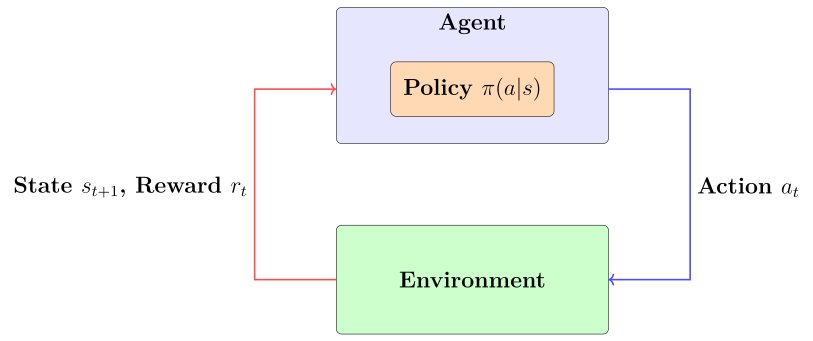
Agent-Environment Interaction Loop: The agent selects actions based on the current state; the environment returns rewards and new states in response. This loop continues until the task ends or indefinitely.
1.2 Fundamental Difference from Supervised Learning
The key difference between RL and supervised learning lies in the data distribution. Supervised learning assumes data is independently and identically distributed (i.i.d.), but in RL the data distribution depends entirely on the current policy—when the policy changes, so does the collected data.
| Property | Supervised Learning | Unsupervised Learning | Reinforcement Learning |
|---|---|---|---|
| Feedback | Labels (correct answers) | None | Reward signal (scalar) |
| Data Distribution | i.i.d. | i.i.d. | Policy-dependent, non-i.i.d. |
| Objective | Minimize prediction error | Discover data structure | Maximize cumulative reward |
| Decision Timing | Single-step independent | No decisions | Sequentially correlated |
This difference creates many challenges in practice: policy changes lead to data distribution changes, which in turn affect policy updates, forming a complex dynamic process.
Three Core Challenges of RL:
- Exploration vs. Exploitation Trade-off: Should we try new actions (explore) or use known good actions (exploit)? Over-exploration wastes resources; over-exploitation may miss better strategies.
- Credit Assignment Problem: How do we attribute the final reward to previous actions? In chess, which move led to the final victory or defeat?
- Non-stationarity: The data distribution changes as the policy changes, making training unstable—this is the fundamental reason RL is harder than supervised learning.
1.3 Application Scenarios
RL has achieved breakthrough progress in many domains:
- Game AI: AlphaGo (Go) defeating world champions, OpenAI Five (Dota 2), AlphaStar (StarCraft)
- Robotics: Robotic arm manipulation, quadruped locomotion, drone control
- Autonomous Driving: Decision planning, path planning
- Recommendation Systems: Optimizing long-term user satisfaction rather than immediate click rates
- LLM Alignment: RLHF (Reinforcement Learning from Human Feedback) has become the standard training pipeline for models like GPT and Claude
Notably, RL’s most successful recent application may not be games, but LLM alignment—see Parts 5 and 6 of this series.
2. Markov Decision Process (MDP)
With intuitive understanding established, let’s build the mathematical framework. MDP is the standard formalization tool for RL, describing the agent-environment interaction as a discrete-time stochastic control process.
2.1 MDP Five-Tuple Definition
Definition (Markov Decision Process): An MDP is defined by the five-tuple $(\mathcal{S}, \mathcal{A}, P, R, \gamma)$:
- $\mathcal{S}$: State Space, the set of all possible states
- $\mathcal{A}$: Action Space, the set of all possible actions
- $P: \mathcal{S} \times \mathcal{A} \times \mathcal{S} \to [0,1]$: Transition Probability, $P(s’|s,a)$ is the probability of transitioning to state $s’$ when taking action $a$ in state $s$
- $R: \mathcal{S} \times \mathcal{A} \to \mathbb{R}$: Reward Function, $R(s,a)$ is the immediate reward for taking action $a$ in state $s$
- $\gamma \in [0,1]$: Discount Factor, balancing the relative importance of immediate vs. future rewards
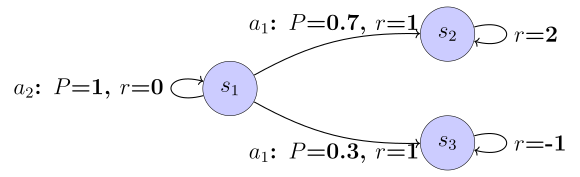
MDP Example: State $s_1$ has two actions: $a_1$ transitions to $s_2$ with 0.7 probability (high reward), or to $s_3$ with 0.3 probability (negative reward); $a_2$ stays in place with no reward.
Note: The reward function has multiple forms: $R(s,a)$, $R(s,a,s’)$, $R(s)$. These can be converted between each other. For example, $R(s,a,s’)$ converts to $R(s,a) = \sum_{s’} P(s’|s,a) R(s,a,s’)$. This article uses $R(s,a)$ by default.
2.2 Markov Property
The core assumption of MDP is the Markov Property, also called “memorylessness”:
Definition (Markov Property): Given current state $s_t$ and action $a_t$, the distribution of next state $s_{t+1}$ and reward $r_t$ depends only on $(s_t, a_t)$, independent of history:
\[P(s_{t+1}, r_t | s_t, a_t) = P(s_{t+1}, r_t | s_0, a_0, s_1, a_1, \ldots, s_t, a_t)\]Intuition: The current state contains all information needed to predict the future. History can be “compressed” into the current state; the state is a “sufficient statistic” of history.
What if the real environment doesn’t satisfy the Markov property? The answer is to expand the state representation:
- History Window: In Atari games, use 4 consecutive frames as state to capture motion
- RNN Hidden State: Use the hidden state of a recurrent network to encode history
- Transformer: Use attention mechanisms to handle variable-length history
Essentially, we encode “history” into the state representation so that the expanded state satisfies the Markov property.
2.3 Classification of State and Action Spaces
Based on the nature of state and action spaces, RL problems can be classified as:
| Type | State Space | Action Space | Typical Examples |
|---|---|---|---|
| Discrete-Discrete | Finite/Countable | Finite/Countable | Board games (board layout × move position) |
| Continuous-Discrete | $\mathbb{R}^n$ | Finite/Countable | Atari games (pixel images × buttons) |
| Continuous-Continuous | $\mathbb{R}^n$ | $\mathbb{R}^m$ | Robotics (joint angles × torques) |
3. Trajectories and Returns
3.1 Trajectory Definition
The state-action-reward sequence generated by agent-environment interaction is called a trajectory, also known as an episode or rollout.
Definition (Trajectory): A trajectory $\tau$ is a sequence of states, actions, and rewards:
\[\tau = (s_0, a_0, r_0, s_1, a_1, r_1, \ldots, s_{T-1}, a_{T-1}, r_{T-1}, s_T)\]where $T$ is the trajectory length (episode termination time).

Trajectory Generation: Policy $\pi$ determines actions, environment $P$ determines state transitions and rewards.
3.2 Trajectory Probability Decomposition
How do we compute trajectory probability?
Theorem (Trajectory Probability Decomposition): Under policy $\pi$, the probability of trajectory $\tau$ is:
\[p(\tau | \pi) = p(s_0) \prod_{t=0}^{T-1} \pi(a_t | s_t) \cdot P(s_{t+1} | s_t, a_t)\]Proof: Using the chain rule of conditional probability and the Markov property:
\[\begin{aligned} p(\tau | \pi) &= p(s_0, a_0, s_1, a_1, \ldots, s_T | \pi) \\ &= p(s_0) \cdot p(a_0 | s_0) \cdot p(s_1 | s_0, a_0) \cdot p(a_1 | s_1) \cdot p(s_2 | s_1, a_1) \cdots \\ &= p(s_0) \prod_{t=0}^{T-1} \underbrace{p(a_t | s_t)}_{\pi(a_t|s_t)} \cdot \underbrace{p(s_{t+1} | s_t, a_t)}_{P(s_{t+1}|s_t,a_t)} \end{aligned}\]The second step uses the Markov property: $p(s_{t+1} | s_0, a_0, \ldots, s_t, a_t) = p(s_{t+1} | s_t, a_t)$.
This decomposition is crucial! Observe the formula:
- $p(s_0)$: Initial state distribution, determined by environment
- $\pi(a_t|s_t)$: Policy, what we want to learn/optimize
- $P(s_{t+1}|s_t,a_t)$: Environment dynamics, determined by environment
Key observation: $p(s_0)$ and $P(s_{t+1}|s_t,a_t)$ are independent of policy parameters $\theta$. Therefore, when computing the gradient of $\log p(\tau|\pi_\theta)$ with respect to $\theta$, the environment dynamics terms vanish! This is the core of the Policy Gradient theorem.
3.3 Return Definition
Definition (Return / Reward-to-go): The return or reward-to-go starting from time $t$ is defined as the discounted cumulative sum of future rewards:
\[G_t = \sum_{k=0}^{\infty} \gamma^k r_{t+k} = r_t + \gamma r_{t+1} + \gamma^2 r_{t+2} + \cdots\]where $\gamma \in [0,1]$ is the discount factor.
The return $G_t$ satisfies a simple but important recursive relation:
\[G_t = r_t + \gamma G_{t+1}\]The Bellman equation is based on this recursive structure—the next article will elaborate in detail.
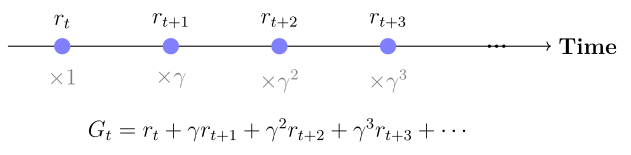
Smaller $\gamma$ means lower weight for distant rewards.
3.4 Episodic vs Continuing Tasks
Based on whether there’s a terminal state, RL problems fall into two categories:
- Episodic Task: Terminal state $s_T$ exists; trajectory has finite length. Examples: board games (win/lose ending), robot completing specific task, one game round
- Continuing Task: No terminal state, $T \to \infty$. Examples: stock trading, continuously running control systems, server scheduling
For continuing tasks, $\gamma < 1$ is required to ensure bounded return. When $\lvert r_t \rvert \leq R_{\max}$:
\[\lvert G_t \rvert \leq \sum_{k=0}^{\infty} \gamma^k R_{\max} = \frac{R_{\max}}{1 - \gamma}\]3.5 Multiple Interpretations of the Discount Factor
The discount factor $\gamma$ is a seemingly simple but richly meaningful hyperparameter:
- $\gamma = 0$: Agent only cares about immediate reward, ignoring future entirely (“myopic”)
- $\gamma = 1$: Agent treats all future rewards equally (only for episodic tasks)
- $0 < \gamma < 1$: Balances immediate and future rewards; larger $\gamma$ means more “far-sighted”
Multiple interpretations of discount factor:
- Mathematical: Ensures infinite sum converges, $G_t$ is bounded
- Economic: Time value of money—”$1 today is worth more than $1 in the future”
- Uncertainty: The further into the future, the less accurate predictions are, so weight should decrease
- Practical: $\gamma$ defines the “effective time horizon.” Rewards beyond $1/(1-\gamma)$ steps decay exponentially to negligible. For example, when $\gamma=0.99$, effective horizon is about 100 steps.
4. Policies and Value Functions
4.1 Policy Definition
Definition (Policy): A policy $\pi$ is a mapping from states to actions, defining how the agent chooses actions in each state. Policies come in two types:
- Deterministic Policy: $\pi: \mathcal{S} \to \mathcal{A}$, i.e., $a = \pi(s)$
- Stochastic Policy: $\pi: \mathcal{S} \times \mathcal{A} \to [0,1]$, i.e., $\pi(a|s)$ is the probability of choosing action $a$ in state $s$
Stochastic policies satisfy normalization: for all $s \in \mathcal{S}$,
\[\sum_{a \in \mathcal{A}} \pi(a|s) = 1\]Why do we need stochastic policies? Isn’t deterministic simpler?
Three advantages of stochastic policies:
- Exploration: Randomness helps explore unknown actions, avoiding local optima
- Adversarial settings: In game scenarios, deterministic policies are predictable by opponents (think rock-paper-scissors)
- Optimization-friendly: Gradients of stochastic policies are easier to compute (deterministic policy gradients involve $\arg\max$, which is non-differentiable)
Deterministic policies can be seen as special cases of stochastic policies (probability concentrated on a single action).
4.2 State Value Function $V^\pi(s)$
Definition (State Value Function): The state value function for policy $\pi$ is defined as the expected return starting from state $s$, following policy $\pi$:
\[V^\pi(s) = \mathbb{E}_\pi \left[ G_t \mid S_t = s \right] = \mathbb{E}_\pi \left[ \sum_{k=0}^{\infty} \gamma^k r_{t+k} \mid S_t = s \right]\]where the expectation is over all possible trajectories under policy $\pi$.
$V^\pi(s)$ answers the question: In state $s$, if we follow policy $\pi$ from now on, what is the expected total reward?
4.3 Action Value Function $Q^\pi(s,a)$
Definition (Action Value Function): The action value function for policy $\pi$ is defined as the expected return when taking action $a$ in state $s$, then following policy $\pi$:
\[Q^\pi(s,a) = \mathbb{E}_\pi \left[ G_t \mid S_t = s, A_t = a \right] = \mathbb{E}_\pi \left[ \sum_{k=0}^{\infty} \gamma^k r_{t+k} \mid S_t = s, A_t = a \right]\]$Q^\pi(s,a)$ provides finer-grained information than $V^\pi(s)$: it allows us to evaluate each action individually, rather than just knowing “the overall expectation following $\pi$.” This enables comparing actions and improving the policy.
4.4 Relationship Between $V$ and $Q$
There’s a simple but important connection between the two value functions:
Theorem (Relationship between $V$ and $Q$):
\[V^\pi(s) = \sum_{a \in \mathcal{A}} \pi(a|s) Q^\pi(s,a) = \mathbb{E}_{a \sim \pi(\cdot|s)} \left[ Q^\pi(s,a) \right]\]Proof: By the law of total expectation:
\[\begin{aligned} V^\pi(s) &= \mathbb{E}_\pi \left[ G_t \mid S_t = s \right] \\ &= \sum_{a \in \mathcal{A}} p(A_t = a | S_t = s) \cdot \mathbb{E}_\pi \left[ G_t \mid S_t = s, A_t = a \right] \\ &= \sum_{a \in \mathcal{A}} \pi(a|s) \cdot Q^\pi(s,a) \end{aligned}\]Intuition: State value $V^\pi(s)$ is the weighted average of action values $Q^\pi(s,a)$, weighted by policy probabilities $\pi(a|s)$.
4.5 Advantage Function $A^\pi(s,a)$
Definition (Advantage Function): The advantage function is defined as the difference between action value and state value:
\[A^\pi(s,a) = Q^\pi(s,a) - V^\pi(s)\]The advantage function measures: how much better or worse action $a$ is compared to the “average level” (sampling actions according to the policy) in state $s$.
Theorem (Key Property of Advantage Function): The expected advantage under the policy distribution is zero:
\[\mathbb{E}_{a \sim \pi(\cdot|s)} \left[ A^\pi(s,a) \right] = 0\]Proof:
\[\begin{aligned} \mathbb{E}_{a \sim \pi(\cdot|s)} \left[ A^\pi(s,a) \right] &= \mathbb{E}_{a \sim \pi} \left[ Q^\pi(s,a) - V^\pi(s) \right] \\ &= \mathbb{E}_{a \sim \pi} \left[ Q^\pi(s,a) \right] - V^\pi(s) \\ &= V^\pi(s) - V^\pi(s) = 0 \end{aligned}\]Intuition of advantage function:
- $A(s,a) > 0$: Action $a$ is better than average
- $A(s,a) < 0$: Action $a$ is worse than average
- $A(s,a) = 0$: Action $a$ is at the average level
The role of advantage functions in Policy Gradient will be discussed in detail in subsequent articles.
4.6 Optimal Policy and Optimal Value Functions
Definition (Optimal Value Functions): The optimal state value function $V^{*}(s)$ and optimal action value function $Q^{*}(s,a)$ are defined as the maximum values achievable across all policies:
\[\begin{aligned} V^*(s) &= \max_\pi V^\pi(s) \\ Q^*(s,a) &= \max_\pi Q^\pi(s,a) \end{aligned}\]Definition (Optimal Policy): Policy $\pi^*$ is called an optimal policy if for all states $s \in \mathcal{S}$:
\[V^{\pi^*}(s) = V^*(s)\]Theorem (Existence of Optimal Policy): For finite MDPs (finite state and action spaces), at least one deterministic optimal policy exists.
The optimal policy can be derived directly from the optimal action value function:
Theorem (Deriving Optimal Policy from $Q^{*}$): Given $Q^{*}$, the optimal policy is:
\[\pi^*(s) = \arg\max_{a \in \mathcal{A}} Q^*(s,a)\]This result is the theoretical foundation of Q-Learning and other value-based methods: if we learn $Q^{*}$, we immediately get the optimal policy.
5. Formal Objective of RL
Combining the above definitions, the objective of reinforcement learning can be formalized as:
Definition (RL Objective): Find optimal policy $\pi^*$ that maximizes expected return:
\[\pi^* = \arg\max_\pi J(\pi)\]where $J(\pi)$ is the policy performance metric, with common definitions including:
- From fixed initial state: $J(\pi) = V^\pi(s_0)$
- Initial state has distribution: $J(\pi) = \mathbb{E}_{s_0 \sim p(s_0)} \left[ V^\pi(s_0) \right]$
- Trajectory expectation: $J(\pi) = \mathbb{E}_{\tau \sim \pi} \left[ \sum_{t=0}^{T} \gamma^t r_t \right]$
These three definitions are equivalent in most cases. Subsequent articles will introduce different methods for solving this optimization problem:
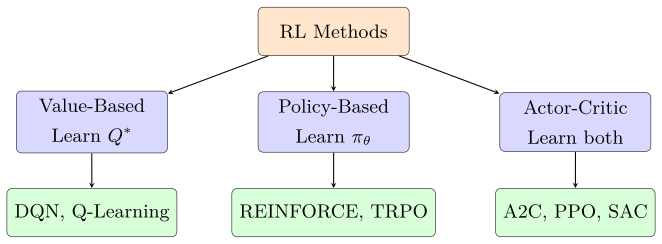
- Value-Based Methods: Learn $V^*$ or $Q^*$, then derive $\pi^*$ via $\arg\max$
- Policy-Based Methods: Directly optimize parameterized policy $\pi_\theta$
- Actor-Critic Methods: Learn both policy (Actor) and value function (Critic)
Summary
Returning to the opening question: how do we teach a machine sequential decision-making? The answer is to formalize the problem as an MDP, with the goal of maximizing expected cumulative reward.
Core concepts established in this chapter:
- MDP Five-Tuple $(\mathcal{S}, \mathcal{A}, P, R, \gamma)$ is the standard formalization framework for RL
- Markov Property: The current state contains all information needed to predict the future
- Trajectory Probability Decomposition: $p(\tau|\pi) = p(s_0) \prod_t \pi(a_t|s_t) P(s_{t+1}|s_t,a_t)$, separating policy from environment dynamics
- Return Recursion: $G_t = r_t + \gamma G_{t+1}$, the starting point for Bellman equations
- Value Functions: $V^\pi$ and $Q^\pi$ measure long-term value of policies
- Advantage Function: $A^\pi(s,a) = Q^\pi(s,a) - V^\pi(s)$, with zero expectation
- RL Objective: $\max_\pi J(\pi)$, finding the policy that maximizes expected return
The next article will introduce Bellman equations—using the recursive structure of returns to efficiently compute value functions—and value-based algorithms like Q-Learning and DQN.
Comments