RL Notes (6): LLM Alignment (Part 2)
2025-12-19 · Qi Lu · Views:
This is the sixth and final article in the Reinforcement Learning series. This article introduces GRPO (online RL without a Critic), KL divergence estimators, On-Policy Distillation, Process Reward Models (PRM), and the challenges and methods of Long CoT RL.
GRPO: Group Relative Policy Optimization
GRPO is a method proposed by DeepSeek that sits between PPO and DPO: it retains online exploration capabilities but doesn’t require a Critic network.
Motivation for GRPO
- PPO’s problem: Requires a Critic network, large memory overhead (an additional large model)
- DPO’s problem: Completely offline, lacks exploration, limited improvement on difficult tasks
GRPO’s approach: Use group-relative rewards to replace the Critic, achieving “online RL without a Critic”.
Group-Normalized Advantage
GRPO Advantage
For prompt $x$, sample a group of responses $\{y_1, \ldots, y_G\}$, compute their respective rewards $\{R_1, \ldots, R_G\}$, then:
\[\hat{A}_i = \frac{R_i - \bar{R}}{\text{Std}(R) + \epsilon}\]where $\bar{R} = \frac{1}{G}\sum_i R_i$ is the group mean, $\text{Std}(R)$ is the group standard deviation.
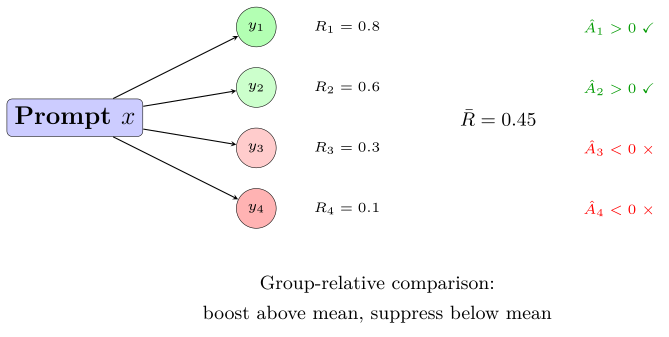
Advantages of group normalization:
- No Critic needed: Use group mean to replace value function estimation
- Baseline effect: Mean subtraction reduces variance
- Scale normalization: Standard deviation normalization makes advantage scale stable
- Relative comparison: Focus on relative quality under the same prompt
GRPO Objective Function
GRPO Objective
\[L_{\text{GRPO}} = \mathbb{E}_{x} \left[ \frac{1}{G} \sum_{i=1}^{G} \sum_{t=1}^{|y_i|} \min \left( \rho_{i,t} \hat{A}_i, \text{clip}(\rho_{i,t}, 1-\epsilon, 1+\epsilon) \hat{A}_i \right) \right]\]where $\rho_{i,t} = \frac{\pi_\theta(y_{i,t}|x, y_{i,<t})}{\pi_{\theta_{\text{old}}}(y_{i,t}|x, y_{i,<t})}$ is the importance sampling ratio.
Key differences between GRPO and PPO:
- PPO: $\hat{A}_t$ is computed by GAE, requires a Critic
- GRPO: $\hat{A}_i$ is constant for the entire sequence, obtained from group normalization
GRPO Practical Tips
-
Clip-Higher: Upper bound can be more lenient (e.g., $1+0.28$ instead of $1+0.2$), allowing good responses to improve more significantly
-
Dynamic Sampling: Filter prompts where all responses are correct or all wrong (advantage is undefined when variance is 0)
-
Length penalty: Prevent generating overly long responses \(R_i = r_\phi(x, y_i) - \lambda \cdot |y_i|\)
-
KL as Loss: KL penalty as a separate loss term, rather than putting it in the reward \(L = -L_{\text{GRPO}} + \lambda_{\text{KL}} \cdot \mathbb{E}[\text{KL}(\pi_\theta \| \pi_{\text{ref}})]\)
KL Divergence Estimation: k1, k2, k3
KL divergence $\text{KL}(\pi_\theta | \pi_{\text{ref}})$ cannot be computed exactly (requires enumerating all possible sequences) and needs Monte Carlo estimation.
Definition of KL Divergence
For two distributions $p$ and $q$:
\[\text{KL}(p \| q) = \mathbb{E}_{x \sim p}\left[ \log \frac{p(x)}{q(x)} \right]\]In the LLM scenario, $p = \pi_\theta$, $q = \pi_{\text{ref}}$, sampling from $\pi_\theta$.
k1 Estimator: Direct Estimation
k1 Estimator
Define ratio $r = \frac{\pi_{\text{ref}}(y|x)}{\pi_\theta(y|x)}$, then:
\[k_1 = -\log r = \log \frac{\pi_\theta(y|x)}{\pi_{\text{ref}}(y|x)}\]
Properties:
- Unbiased: $\mathbb{E}_{y \sim \pi_\theta}[k_1] = \text{KL}(\pi_\theta | \pi_{\text{ref}})$
- High variance: When $\pi_\theta$ and $\pi_{\text{ref}}$ differ significantly, variance is very large
Usage: Usually put in reward \(r_t^{\text{RL}} = r_t^{\text{RM}} - \beta \cdot k_1^{(t)}\)
k2 Estimator: Squared Form
k2 Estimator
\[k_2 = \frac{1}{2}(\log r)^2 = \frac{1}{2} \left( \log \frac{\pi_{\text{ref}}(y|x)}{\pi_\theta(y|x)} \right)^2\]
Properties:
- Biased: $\mathbb{E}[k_2] \neq \text{KL}$
- Gradient equivalent: $\nabla_\theta \mathbb{E}[k_2] = \nabla_\theta \text{KL}$
- Smoother: Squared form is smoother around $r=1$
Usage: Suitable as a loss term (because the gradient is correct)
k3 Estimator: Control Variate
k3 Estimator
\[k_3 = (r - 1) - \log r = \frac{\pi_{\text{ref}}(y|x)}{\pi_\theta(y|x)} - 1 - \log \frac{\pi_{\text{ref}}(y|x)}{\pi_\theta(y|x)}\]
k3 Properties Theorem: k3 is an unbiased and low-variance KL estimator.
Proof:
Unbiasedness: \(\begin{align} \mathbb{E}_{y \sim \pi_\theta}[k_3] &= \mathbb{E}[(r-1)] - \mathbb{E}[\log r] \\ &= \underbrace{\mathbb{E}\left[\frac{\pi_{\text{ref}}}{\pi_\theta}\right] - 1}_{= 0} + \mathbb{E}\left[\log \frac{\pi_\theta}{\pi_{\text{ref}}}\right] \\ &= \text{KL}(\pi_\theta \| \pi_{\text{ref}}) \end{align}\)
where $\mathbb{E}_{y \sim \pi_\theta}\left[\frac{\pi_{\text{ref}}(y)}{\pi_\theta(y)}\right] = \sum_y \pi_\theta(y) \cdot \frac{\pi_{\text{ref}}(y)}{\pi_\theta(y)} = \sum_y \pi_{\text{ref}}(y) = 1$.
Low variance: The $(r-1)$ term is a control variate with zero expectation, negatively correlated with $\log r$, reducing variance.
Comparison of Three Estimators
| Estimator | Formula | Bias | Variance | Recommended Usage |
|---|---|---|---|---|
| k1 | $\log \frac{\pi_\theta}{\pi_{\text{ref}}}$ | Unbiased | High | KL in reward |
| k2 | $\frac{1}{2}(\log \frac{\pi_{\text{ref}}}{\pi_\theta})^2$ | Biased | Low | KL as loss |
| k3 | $\frac{\pi_{\text{ref}}}{\pi_\theta} - 1 - \log \frac{\pi_{\text{ref}}}{\pi_\theta}$ | Unbiased | Low | KL as loss |
Two Usage Patterns for KL:
- KL in Reward (classical RLHF):
- Token reward minus $\beta \cdot k_1$
- Then update with PPO-Clip
- Advantage: Directly affects each step’s decision
- KL as Loss (GRPO, etc.):
- Total loss = $-L_{\text{RL}} + \lambda \cdot \mathbb{E}[k_3]$
- Advantage: More stable, lower variance
On-Policy Distillation
On-Policy Distillation is an important advancement in LLM post-training in recent years, combining the advantages of RL and knowledge distillation.
Motivation: Distribution Shift Problem in Off-policy Distillation
Traditional knowledge distillation (SFT on teacher data) is off-policy:
The student learns from teacher-generated data, but the states visited during inference may be completely different from those during training.
This leads to compounding errors — the student hasn’t seen its own mistakes during training, so once it deviates from the teacher’s trajectory, it continues to deteriorate.
Comparison of Three Post-Training Paradigms
| Method | Sampling Source | Reward Density | Characteristics |
|---|---|---|---|
| SFT (Supervised Fine-Tuning) | Teacher data (Off-policy) | Dense | Distribution constrained |
| RL (Reinforcement Learning) | Self-sampling (On-policy) | Sparse | High search cost |
| On-Policy Distillation | Self-sampling | Dense | Combines both advantages |
Core idea of On-Policy Distillation:
- Student samples itself (On-policy): Avoids distribution shift
- Teacher scores token-by-token (Dense reward): Provides dense supervision signal
Reverse KL Loss
On-Policy Distillation uses reverse KL divergence as the loss function:
\[L_{\text{OPD}} = D_{\text{KL}}(\pi_\theta \| \pi_{\text{teacher}}) = \mathbb{E}_{y \sim \pi_\theta}\left[ \sum_t \log \frac{\pi_\theta(y_t | x, y_{<t})}{\pi_{\text{teacher}}(y_t | x, y_{<t})} \right]\]Forward KL vs Reverse KL:
- Forward KL $D_{\text{KL}}(\pi_{\text{teacher}} | \pi_\theta)$: mode covering, student tries to cover all modes of the teacher
- Reverse KL $D_{\text{KL}}(\pi_\theta | \pi_{\text{teacher}})$: mode seeking, student focuses on teacher’s high-probability regions
Reverse KL is more suitable for distillation scenarios — let the student imitate the teacher in states it visits, rather than trying to cover all teacher behaviors.
KDRL: Combining Knowledge Distillation and Reinforcement Learning
KDRL (Knowledge Distillation + Reinforcement Learning) unifies teacher supervision and reward-driven self-exploration into joint optimization:
\[\mathcal{J}_{\text{KDRL}}(\theta) = \underbrace{\mathcal{J}_{\text{GRPO}}(\theta)}_{\text{reward-driven}} - \beta \cdot \underbrace{D_{\text{KL}}^{k_2}(\pi_\theta \| \pi_{\text{teacher}})}_{\text{teacher supervision}}\]Key design choices:
- KL estimator choice: $k_2$ is superior to $k_3$, as $k_2$ provides unbiased gradient estimation
- Coefficient annealing: Gradually transition from strong imitation (large $\beta$) to reward-driven (small $\beta$)
- Reward-guided masking: Apply KD only on low-reward samples, reducing output length while maintaining accuracy
Efficiency Advantages
Efficiency improvements of On-Policy Distillation (using math reasoning tasks as example):
- Compared to RL: 7-10x faster training, 50-100x overall computational efficiency improvement
- Compared to offline distillation: 9-30x reduction in computational cost
- Qwen3 experiments: Distillation significantly outperforms RL, GPU hours only ~1/10 of RL
Fundamental reason for efficiency improvement:
The dense token-level signal provided by the teacher contains much more information than RL’s sparse sequence-level reward.
Most of RL’s computation is spent on searching (exploring policy space), while distillation directly uses teacher knowledge to guide the student to make correct choices at critical “fork points”.
Application Scenarios
- Small model specialization: Use large models (e.g., Qwen3-235B) to distill small models (e.g., Qwen3-32B)
- Continual learning: After training on new domain knowledge, use distillation to recover forgotten instruction-following capabilities
- Behavior recovery: Recover specific capabilities from earlier checkpoints
Qwen3’s Findings:
- Distillation not only matches RL performance, but also expands the exploration space
- pass@64 scores improve after distillation, while RL shows no improvement on pass@64
- Reason: Distillation learns the teacher’s complete distribution, not just a single optimal answer
Process Reward Model (PRM)
PRM provides process-level supervision, transforming sparse terminal rewards into dense step-level rewards.
ORM vs PRM
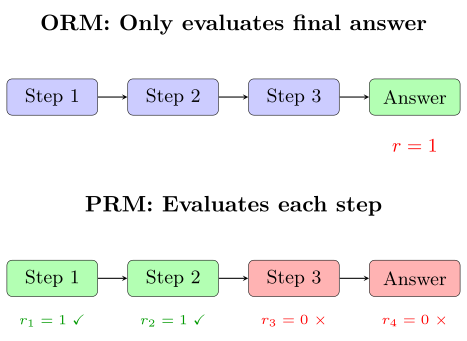
ORM and PRM
- ORM (Outcome Reward Model): Only looks at final result
- Input: $(x, y)$
- Output: Correctness score of final answer
- PRM (Process Reward Model): Evaluates each intermediate step
- Input: $(x, y_{\leq t})$
- Output: Correctness score up to step $t$
Advantages of PRM
- Clearer credit assignment: Feedback at every step, know which step went wrong
- Faster convergence for long-chain reasoning: Dense reward is easier to learn than sparse reward
- Supports early stopping: If intermediate step scores keep dropping, can truncate and resample
- Supports Best-of-N: Use cumulative PRM score to select the best reasoning path
PRM Training
PRM training data sources:
- Human annotation: Experts annotate correctness of each reasoning step
- Automatic annotation: Infer intermediate steps from final answer correctness
- MCTS exploration: Search to discover correct/incorrect branch points
PRM reward for RL:
\[r_t = \text{PRM}(x, y_{\leq t}) - \text{PRM}(x, y_{\leq t-1})\]i.e., the “marginal contribution” of each step.
Long CoT RL
RL training for long Chain-of-Thought sequences (Long CoT) faces unique challenges. With the emergence of reasoning models like o1 and DeepSeek-R1, this has become an important research direction.
Challenges of Long Sequence RL
-
Variance explosion: Token-level importance sampling weights accumulate, causing exponential variance growth \(\prod_{t=1}^{T} \frac{\pi_\theta(y_t|s_t)}{\pi_{\text{old}}(y_t|s_t)} \approx e^{\sum_t \delta_t}\) When $T$ is large (thousands of tokens), the variance of this product explodes.
-
Policy shift: Long sequences make $\pi_\theta$ and $\pi_{\text{old}}$ diverge more
-
Sparse reward harder: Only the final answer has feedback, signal must propagate thousands of steps

GSPO: Sequence-level IS
GSPO (Group Sequence Policy Optimization) uses sequence-level importance sampling:
GSPO Sequence-level IS
Define length-normalized sequence-level IS weight:
\[w_i(\theta) = \left( \frac{\pi_\theta(y_i|x)}{\pi_{\text{old}}(y_i|x)} \right)^{1/|y_i|} = \exp\left( \frac{1}{|y_i|} \sum_t \log \frac{\pi_\theta(y_{i,t}|s_{i,t})}{\pi_{\text{old}}(y_{i,t}|s_{i,t})} \right)\]After length normalization then clip, all tokens share the same weight.
GSPO advantages:
- Avoids variance explosion from token-level weight multiplication
- Length normalization makes sequences of different lengths comparable
- Maintains PPO-Clip’s stability
CISPO: Clipped IS-weight
CISPO (Clipped Importance Sampling Policy Optimization) adopts a different strategy:
- Maintains GRPO’s group normalization
- Returns to token-level REINFORCE
- Clip IS weights (not loss):
Kimi k1.5 Technical Points
Kimi k1.5’s long CoT RL recipe:
- Ultra-long context: 128k context direct RL
- Mirror Descent update: More conservative policy updates
- Partial rollout: Don’t need complete generation, truncate and use value estimation
- Asynchronous train/infer: Separate training and inference to improve efficiency
- Repetition detection + early stopping: Truncate when loop generation is detected
- Length penalty: Encourage concise reasoning
Long2Short RL (long to short distillation):
- Long CoT model as teacher
- Train short CoT student
- Reward = correctness + token count penalty
- Goal: both correct and concise
DeepSeek-V3.2 Improvements
DeepSeek-V3.2’s improvements to GRPO (core idea: make off-policy training behave as close to on-policy as possible):
-
Unbiased KL Estimate: Use IS ratio to correct k3’s off-policy bias \(\hat{\text{KL}} = \mathbb{E}_{\pi_{\text{old}}}\left[ \frac{\pi_\theta}{\pi_{\text{old}}} \cdot k_3 \right]\)
-
Off-Policy Sequence Masking: Sequences with negative advantage and excessive KL divergence are masked
-
Keep Routing (MoE-specific): Maintain expert routing paths from sampling time
-
Keep Sampling Mask: Maintain top-p/top-k truncation mask
Token-level vs Sequence-level Objectives
First-Order Approximation Theory
Token-level objectives (like REINFORCE, GRPO) are first-order approximations of sequence-level objectives.
Let $\frac{\pi_\theta(y_t|s_t)}{\pi_{\theta_{\text{old}}}(y_t|s_t)} = 1 + \delta_t$, where $\delta_t$ is a small quantity, then:
\[\prod_t (1 + \delta_t) \approx 1 + \sum_t \delta_t \quad \text{(first-order Taylor expansion)}\]Therefore, when policy changes are small:
\[\nabla \mathcal{J}^{\text{seq}} \approx \nabla \mathcal{J}^{\text{token}}\]Condition for validity: $\pi_\theta \approx \pi_{\theta_{\text{old}}}$, i.e., each update step is sufficiently small.
Training-Inference Discrepancy
In practice, sampling distribution $\mu$ may differ from training-time $\pi_{\theta_{\text{old}}}$:
\[\frac{\pi_\theta(y)}{\mu(y)} = \underbrace{\frac{\pi_{\theta_{\text{old}}}(y)}{\mu(y)}}_{\text{train-infer gap}} \times \underbrace{\frac{\pi_\theta(y)}{\pi_{\theta_{\text{old}}}(y)}}_{\text{policy staleness}}\]Both factors can cause first-order approximation to fail:
- Train-infer gap: Different sampling strategies between training and inference (e.g., temperature, top-p)
- Policy staleness: In asynchronous training, data comes from old policy
Chapter Summary
- GRPO: Uses group-relative rewards to replace Critic, achieving online RL without a Critic
- Group normalization: $\hat{A}_i = \frac{R_i - \bar{R}}{\text{Std}(R)}$
- Retains exploration capability, lower memory overhead than PPO
- KL estimators:
- k1 (unbiased high variance): suitable for KL in reward
- k2 (biased low variance): suitable for KL as loss
- k3 (unbiased low variance): recommended for KL as loss
- On-Policy Distillation:
- Combines RL exploration and distillation efficiency
- Reverse KL lets student learn on its own distribution
- 10-100x more efficient than pure RL
- PRM: Process reward model, provides dense reward signal
- Evaluates each step, solves credit assignment problem of sparse rewards
- Supports Best-of-N selection and early stopping
- Long CoT RL:
- GSPO/CISPO solve long sequence variance explosion
- Sequence-level IS replaces token-level IS
- Kimi, DeepSeek practical techniques

Series Summary
This series consists of six articles, systematically introducing the complete knowledge system from RL fundamentals to LLM applications:
- RL Fundamentals: MDP, trajectories, value functions, RL objectives
- Value-Based RL: Bellman equations, Q-Learning, DQN
- Policy-Based RL: Policy Gradient, REINFORCE, Actor-Critic, PPO
- Model-Based RL & MARL: World Model, MCTS, AlphaZero, Self-Play
- LLM Alignment (Part 1): RLHF, Bradley-Terry, DPO
- LLM Alignment (Part 2): GRPO, KL estimators, PRM, Long CoT RL
I hope this series helps readers establish a complete RL knowledge framework and understand its core role in modern LLM alignment.
Comments